Consolidated endpoint governance across Windows, macOS, iOS, iPadOS and Android where a unified platform is strategically appropriate.
Apple to Intune migration, Jamf to Intune migration, macOS Intune migration, Apple device management migration
Jamf to Intune Migration Consultants
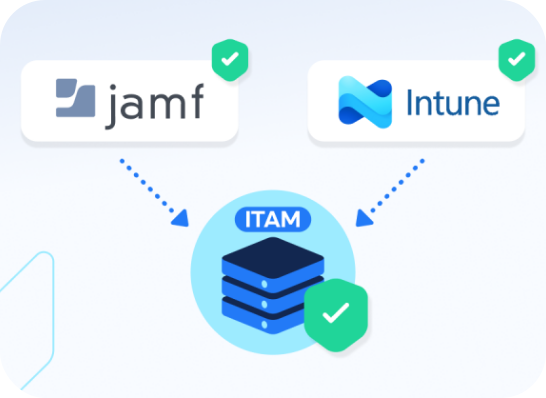
Migrate macOS, iPhone and iPad management from Jamf to Microsoft Intune with structured discovery, policy mapping, application migration and phased enrollment.

Introduction
Enterprises often adopt Jamf to deliver specialized Apple management and later consider Microsoft Intune to consolidate endpoint operations, simplify licensing or align Apple devices with a broader Microsoft security strategy. A successful transition requires careful handling of Apple Business Manager, automated device enrollment, FileVault, configuration profiles, certificates, applications, security extensions and user experience. DeepCoder provides Jamf migration consultants who help organizations plan and execute a controlled Jamf to Intune migration without treating macOS as a Windows device.
Our Apple-to-Intune migration approach evaluates both the capabilities available in the target platform and the business value of each existing Jamf control. Some configurations can be translated directly, others need redesign, and a small number may require alternative tooling or a documented exception. We make those decisions transparent so leaders understand functionality, risk, cost and support implications before migration begins.
Benefits
Improved integration with Microsoft Entra ID, Conditional Access, Microsoft Defender for Endpoint and the wider Microsoft security ecosystem.
Reduced migration disruption through device segmentation, pilot groups, clear user instructions and phased re-enrollment.

Protection of critical Apple controls including FileVault recovery keys, platform SSO, certificates, privacy permissions and system extensions.
Better operational clarity through policy mapping, gap analysis, exception management and ownership of residual Apple-specific requirements.
A repeatable process for migrating applications, configuration profiles and enrollment workflows across global device populations.
Service Offerings

Jamf estate assessment
We inventory enrolled devices, PreStage configurations, configuration profiles, policies, scripts, packages, extension attributes, smart groups, compliance integrations, certificates and Apple Business Manager dependencies.

Capability and gap mapping
Each required control is mapped to an Intune equivalent, redesign option, third-party dependency or exception. We highlight differences in inventory, patching, scripting, application deployment, security controls and reporting.
Apple enrollment architecture
We design Apple Business Manager token management, automated device enrollment profiles, Company Portal or account-driven enrollment, user affinity, supervised iOS and iPadOS scenarios, and macOS onboarding workflows.

Security configuration migration
Our specialists address FileVault escrow, recovery-key rotation, Gatekeeper, firewall, platform SSO, passwordless options, Microsoft Defender, system extensions, privacy preferences, web filtering, certificates, VPN and Wi-Fi.

Application migration
We prepare line-of-business applications, Microsoft 365, browser, security, collaboration and productivity tools for Intune deployment. Installation logic, detection, updates, licensing and uninstall behaviour are tested before broad rollout.

Pilot, communication and cutover
We define device cohorts, re-enrollment steps, service-desk guidance, user communication and migration windows. Results are measured against security, usability, enrollment and application success criteria.

Post-migration optimization
Following cutover, we review compliance, failures, user impact and operational workload, then close gaps and retire Jamf components only after migration evidence is complete.
Why Choose Us
DeepCoder understands the operational reality of endpoint migration. Applications may depend on legacy packaging methods, devices may be rarely connected to the corporate network, business units may have conflicting policies and frontline or kiosk scenarios may require different treatment. Our consultants account for these conditions from the start.
We combine migration engineering with enterprise architecture, security and service-transition disciplines. This allows us to manage not only the technical move, but also the decisions that determine long-term value: which workloads should remain hybrid, which controls should be redesigned, how support teams will operate and how success will be measured. Our deliverables include current-state findings, target architecture, migration factory processes, pilot evidence, wave plans, risk registers, runbooks and executive status reporting.
Migration progress is measured through meaningful indicators such as eligible-device coverage, enrollment success, application readiness, compliance attainment, user-impact volume and legacy workload closure. We use these measures to identify blocked cohorts early and to distinguish technical completion from genuine service adoption. This disciplined reporting gives program sponsors a reliable view of risk and value, while helping engineering and support teams focus on the issues that could delay migration or weaken the target operating model.