Reduced risk of credential theft, unauthorized access, lateral movement and unmanaged-device exposure.
endpoint security services, Zero Trust security services, enterprise security consulting, device trust and access security
Zero Trust Security Consulting Services
Design and implement Zero Trust across identity, endpoints, applications, data and access with enterprise security consulting and measurable controls from DeepCoder.

Introduction
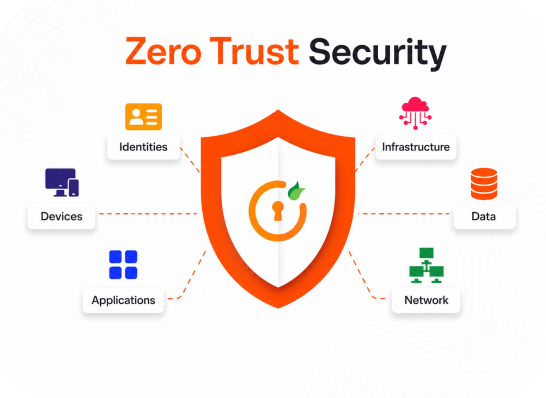
Traditional perimeter security cannot adequately protect a workforce that uses cloud applications, unmanaged networks, mobile devices and third-party access. Zero Trust replaces implicit trust with continuous verification, least privilege and evidence-based access decisions. DeepCoder delivers Zero Trust consulting and endpoint security services that help enterprises turn these principles into a practical, phased security program.
We begin by assessing how identities, devices, applications, data, networks and security operations work together today. The objective is not to purchase every available security product. It is to identify the highest-risk trust assumptions, define measurable control outcomes and introduce improvements in an order the organization can operate successfully.
Benefits
Consistent access decisions based on identity, authentication strength, device health, location, application sensitivity and risk.
Improved endpoint resilience through configuration baselines, encryption, threat protection, application control and patch governance.

Lower standing privilege through just-in-time access, role governance and stronger administrative controls.
Better visibility and response through integrated identity, endpoint, cloud and security telemetry.
A prioritized roadmap that connects security investment with business risk, compliance obligations and operational maturity.
Service Offerings
Zero Trust maturity assessment
We evaluate current controls across identity, endpoints, applications, data, infrastructure, network access and security operations. The assessment identifies trust gaps, dependencies and recommended priorities.
Identity and access security
Our services cover multifactor authentication, passwordless access, Conditional Access, identity-risk policy, guest governance, privileged identity management, access reviews and lifecycle controls.
Endpoint security services
We design secure configurations for Windows, macOS, iOS and Android, including Microsoft Intune, compliance, encryption, Microsoft Defender, firewall, attack-surface reduction, endpoint detection and response, local administrator governance and update management.
Device trust and secure access
We establish policies that distinguish compliant corporate devices, managed personal devices, unmanaged endpoints, shared devices and privileged workstations. Access levels are aligned with application and data sensitivity.

Application and data protection
We assess single sign-on, application ownership, secrets, legacy authentication, mobile application protection, data-loss prevention, sensitivity labeling and secure collaboration.
Secure remote and network access
We evaluate VPN dependencies, private application access, segmentation, cloud-delivered security and identity-aware access patterns to reduce unnecessary network trust.
Security operations integration
We connect control design with alerting, investigation, incident response, logging, metrics and executive reporting. This ensures that preventive controls and operational detection reinforce one another.

Roadmap and implementation governance
We define workstreams, target outcomes, risk reduction measures, pilots, dependencies, investment phases and policy ownership.
Why Choose Us
DeepCoder's strength is the integration of identity, endpoint, cloud, application and infrastructure thinking. Zero Trust programs often underperform when security teams define policy without considering device operations, user productivity, application compatibility or service-desk readiness. We bring these perspectives together in one transformation model.
Our approach is pragmatic. Controls are risk-based, validated in representative scenarios and introduced through measurable phases. We identify where legacy applications or operational constraints require compensating controls, and we document exceptions instead of allowing hidden bypasses. The result is a Zero Trust program that is technically credible, understandable to leadership and sustainable for operational teams.
Leadership reporting is built around demonstrable risk reduction rather than product deployment counts. We define measures such as strong-authentication coverage, compliant-device access, privileged-role exposure, unmanaged access, encryption adoption, critical vulnerability age and exception closure. These indicators help executives understand whether the program is changing security outcomes, while allowing technical teams to identify where policy, user behaviour, legacy technology or operational capacity is limiting progress.