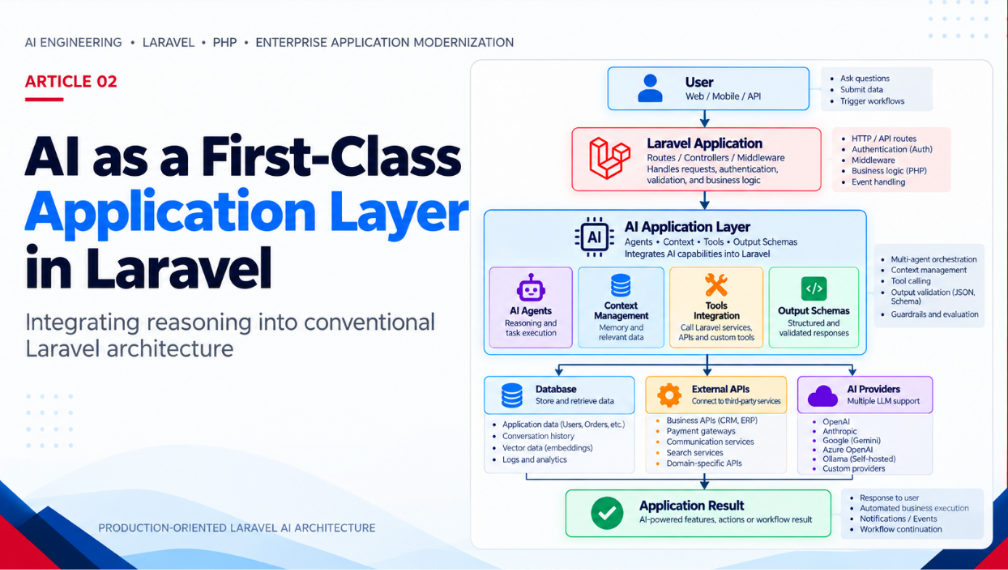
Artificial intelligence is rapidly becoming part of modern business applications. For Laravel teams, the engineering challenge is not simply connecting to an AI provider; it is designing an application architecture in which AI behavior, data, tools, security and business workflows work together.
Architecture Flow
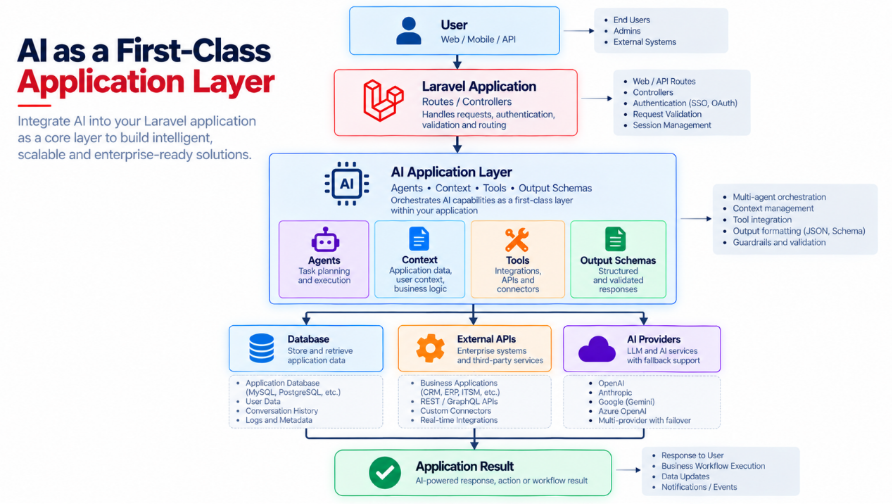
Figure — AI as a First-Class Application Layer in Laravel architecture flow
Introduction
Traditional Laravel applications are built around deterministic request processing: routes, controllers, services, databases, APIs, jobs and events. AI introduces another type of behavior: reasoning over context and deciding which controlled application capabilities may be needed.
The goal is not to replace conventional Laravel architecture. The goal is to introduce an AI application layer that works alongside it.
Traditional Laravel vs AI-Enabled Architecture
A conventional flow can be represented as Request → Controller → Service → Database/API → Response.
An AI-enabled flow adds an AI agent and supporting components between the application request and the deterministic business workflow: Request → Laravel Application → AI Agent → Reasoning/Context → Tools/Retrieval/Other Agents → Validation/Governance → Business Workflow → Response.
What Belongs in the AI Layer?
The source architecture places agents, context, tools, structured output, conversations, streaming and RAG within the AI application layer.
The layer should coordinate AI behavior while leaving authorization, persistence and business-critical execution under application control.
Why Separation Matters
Without separation, prompts, provider calls and AI-specific logic can spread across controllers and services. That makes changes harder to test and increases the risk that AI output becomes tightly coupled to business execution.
A dedicated AI layer creates clearer boundaries for testing, monitoring, provider changes and future expansion.
A Practical Laravel Structure
Routes and controllers can remain responsible for request handling and authentication. Agents can manage AI instructions and reasoning. Tools can expose controlled application capabilities. Services can continue to implement deterministic business logic. Queues can handle long-running work. Events can support audit and operational workflows.
This allows teams to add AI without discarding the architecture that already supports the Laravel application.
Architecture Principles
Keep intelligence flexible, but keep application control deterministic where required.
Do not let a prompt become an authorization boundary.
Validate AI-generated data before it reaches business-critical workflows.
Give agents only the tools and data required for their responsibility.
Key Takeaways
AI becomes another application component, not a replacement for Laravel.
Clear boundaries improve maintainability and governance.
The AI layer should connect reasoning with controlled application capabilities.
Production Implementation Pattern
- Keep controllers focused on request handling.
- Keep deterministic business rules in services/workflows.
- Use agents for AI reasoning.
- Use tools for controlled application capabilities.
- Validate and govern the result before execution.
Frequently Asked Questions
Does AI replace traditional Laravel architecture?
No. The source guide describes AI as an additional layer that works alongside controllers, services, databases, queues, APIs and workflows.
Where should business logic live?
Business-critical deterministic rules should remain in application services and workflows rather than being delegated entirely to model output.
Why separate AI behavior?
Separation makes testing, provider changes, security controls and observability easier to manage.
Build Your AI-Powered Laravel Application with DeepCoder
AI adoption is moving from experimentation toward production application architecture. Organizations need more than an AI model; they need application engineering, AI integration, security, cloud infrastructure, data architecture, governance and operational expertise.
DeepCoder helps organizations design, develop and modernize enterprise applications with AI engineering, Laravel/PHP development, enterprise integrations and production-oriented architecture.
Talk to DeepCoder • [email protected] • www.DeepCoder.io
Recommended Reading in This Laravel AI Series
Editorial note: This article is derived from the DeepCoder Laravel AI SDK Production Guide and preserves its production-oriented architecture, terminology and flow diagrams.