Artificial intelligence is rapidly becoming part of modern business applications. For Laravel teams, the engineering challenge is not simply connecting to an AI provider; it is designing an application architecture in which AI behavior, data, tools, security and business workflows work together.
Architecture Flow
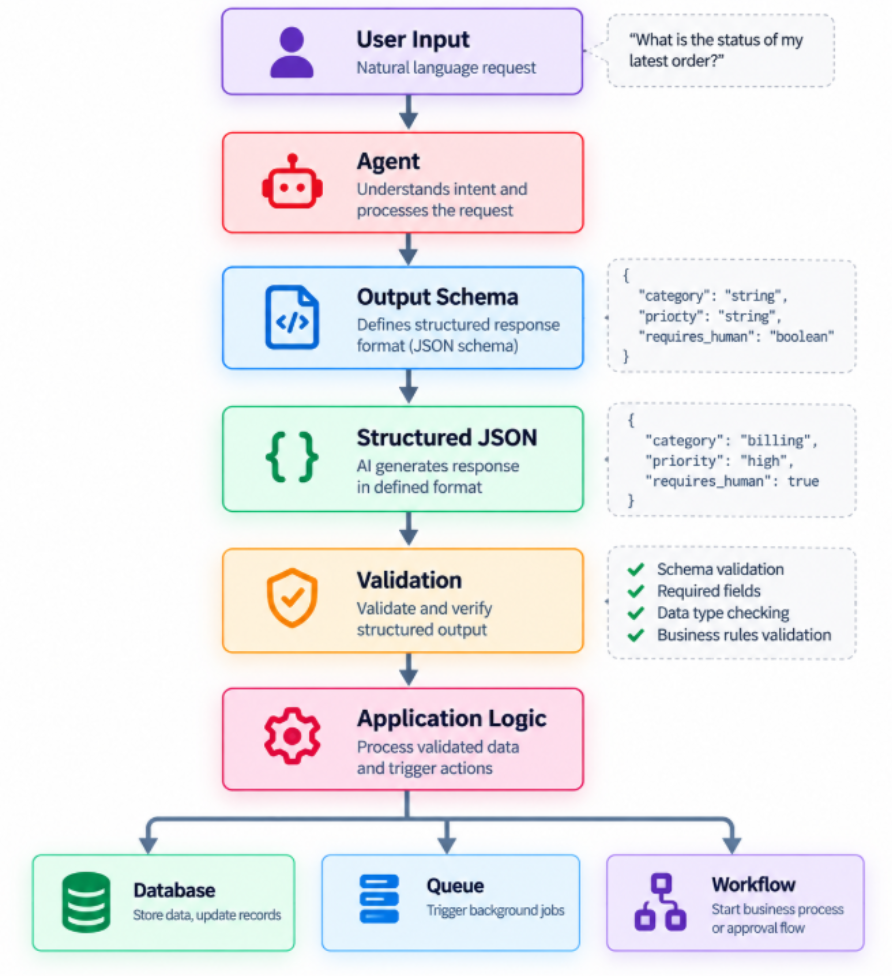
Figure — Structured AI Output in Laravel: From AI Responses to Business Workflows architecture flow
Introduction
Traditional AI responses are often free-form text. Enterprise applications frequently need structured data that can be validated, stored and routed through deterministic workflows.
The Laravel AI SDK supports structured output schemas for agents, creating a bridge between AI-generated information and application logic.
Why Structured Output Matters
Consider a support classification result containing category, priority and whether human review is required. A structured object is easier for application code to validate than a paragraph describing the same information.
Structured output can therefore become an interface between an AI agent and a business workflow.
Structured Output Flow
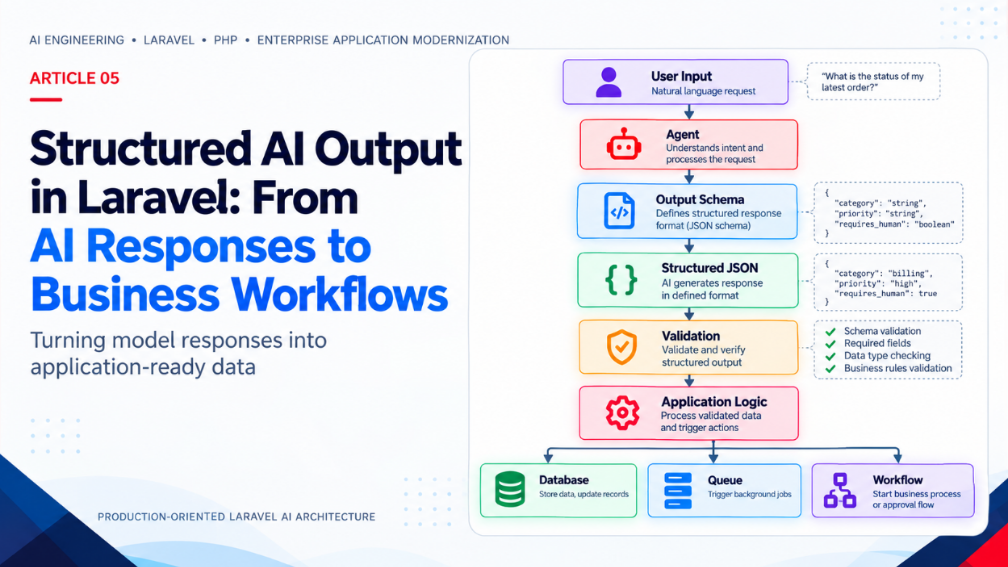
The source flow is User Input → Agent → Output Schema → Structured JSON → Validation → Business Logic → Database, Queue or Workflow.
The schema defines the expected fields and types, while application validation determines whether the result is acceptable for the next step.
Common Enterprise Uses
The source guide identifies lead qualification, invoice processing, support-ticket classification, document extraction and workflow routing as examples where structured output is useful.
The same pattern can be applied to many business processes that require machine-readable AI results.
Validation Is Still Required
A structured schema does not mean the content is automatically correct. The application should validate required fields, allowed values, ranges, permissions and business rules before using the result.
For high-impact actions, validation can be combined with human approval.
Structured Output and Queues
Structured results can also drive asynchronous workflows. For example, an AI classification result can determine which queue receives a task, or extracted document fields can enter a review process.
Design Guidelines
Keep schemas small and purposeful. Use explicit field names. Validate business constraints after schema validation. Log important decisions for auditability. Avoid allowing model output to bypass application authorization.
Key Takeaways
Structured output creates a predictable interface between AI and application logic.
Schema validation and business validation are separate concerns.
Structured results are especially useful for workflow automation and document processing.
Production Implementation Pattern
- Define an explicit output schema.
- Validate schema and field types.
- Apply business rules.
- Route validated results to workflows, queues or databases.
- Require approval for high-impact actions.
Frequently Asked Questions
What is structured AI output?
It is AI-generated data returned according to a defined schema rather than unrestricted free-form text.
Does structured output guarantee accuracy?
No. The source guide emphasizes application validation and business rules.
Where is it useful?
Lead qualification, invoice processing, ticket classification, document extraction and workflow routing are examples from the guide.
Build Your AI-Powered Laravel Application with DeepCoder
AI adoption is moving from experimentation toward production application architecture. Organizations need more than an AI model; they need application engineering, AI integration, security, cloud infrastructure, data architecture, governance and operational expertise.
DeepCoder helps organizations design, develop and modernize enterprise applications with AI engineering, Laravel/PHP development, enterprise integrations and production-oriented architecture.
Talk to DeepCoder • [email protected] • www.DeepCoder.io
Recommended Reading in This Laravel AI Series
Editorial note: This article is derived from the DeepCoder Laravel AI SDK Production Guide and preserves its production-oriented architecture, terminology and flow diagrams.