Artificial intelligence is rapidly becoming part of modern business applications. For Laravel teams, the engineering challenge is not simply connecting to an AI provider; it is designing an application architecture in which AI behavior, data, tools, security and business workflows work together.
Architecture Flow
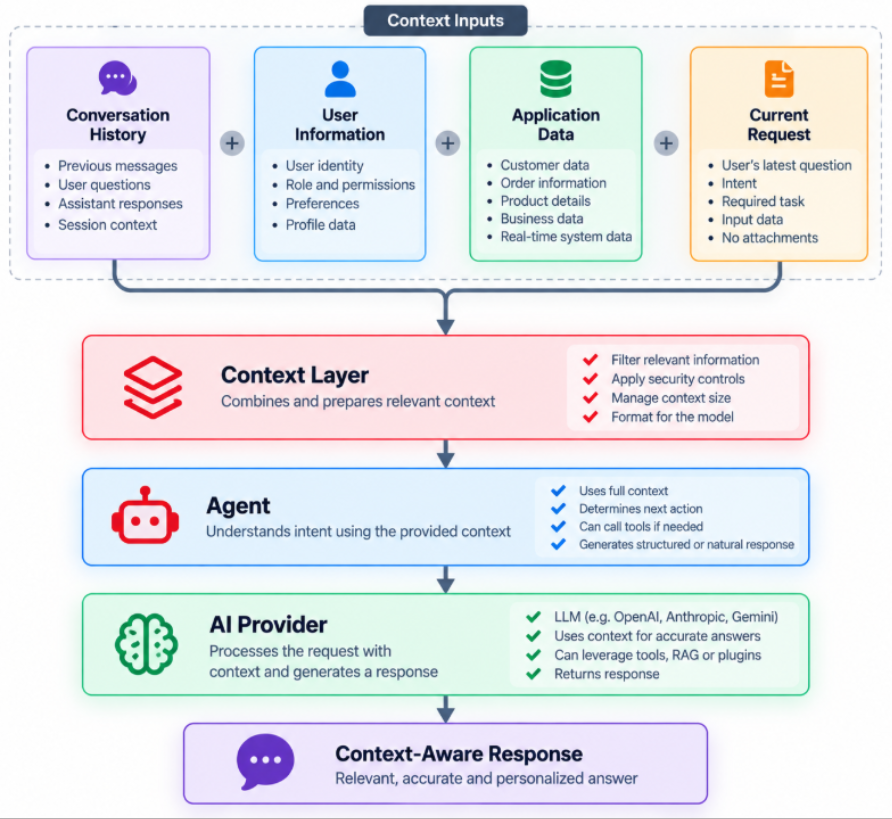
Figure — Laravel AI Memory and Context: Building Context-Aware Applications architecture flow
Introduction
An AI response is only as useful as the information available to the workflow. Enterprise applications may need to combine conversation history, user information, application data and the current request.
The source guide treats context as an architectural layer rather than simply passing the entire conversation to a model.
What Is AI Context?
Context is the relevant information supplied to an AI workflow so that the agent can understand the current task. It can include prior conversation, user information, application data and the current request.
The important word is relevant. More context does not automatically produce better results.
Context Architecture
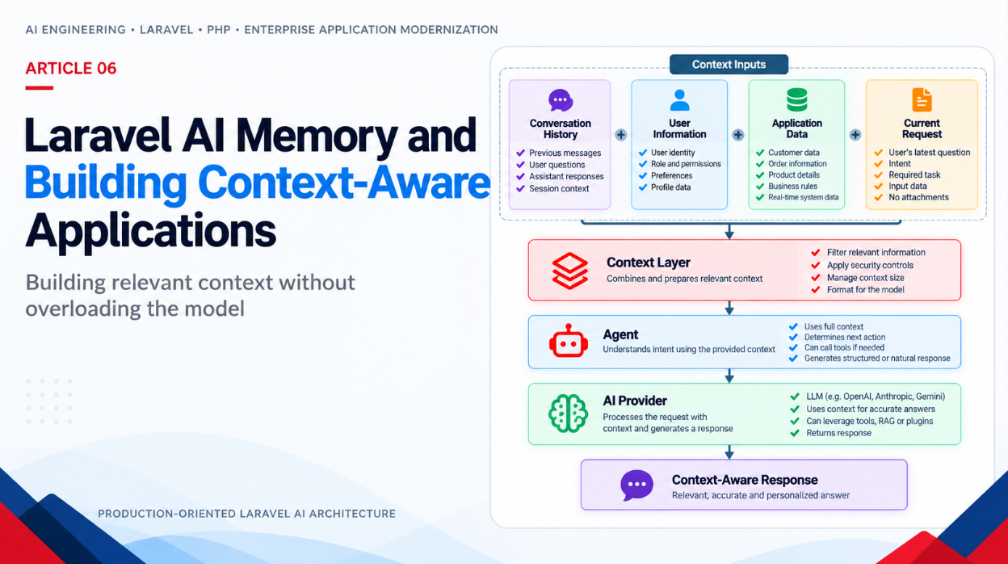
The source diagram shows User Request → Conversation Memory, User Information, Application Data and Current Request → Context Layer → Agent → AI Provider → Context-Aware Response.
This structure allows the application to select and prepare context before the model is called.
Context Selection
Teams should consider data sensitivity, context size, relevance, retention, access control, cost and latency. These factors determine what should be included and how much context is appropriate.
For example, a support agent may need the current customer account and relevant conversation history, but not unrelated records.
Memory vs Business Data
Conversation memory is not a replacement for the system of record. Customer, order and account information should remain in authoritative application databases while the AI layer retrieves the relevant subset.
This separation helps preserve data integrity and permission boundaries.
Context and Security
Context selection should respect user authorization and tenant boundaries. Sensitive information should not be inserted into a prompt simply because it is available to the application.
Access control should be enforced before data becomes AI context.
Context and Cost
Large context windows can increase token usage and latency. Retrieval, summarization and selective history can help keep context focused.
The source guide therefore treats context size and cost as production considerations.
Key Takeaways
Context should be relevant, permission-aware and purpose-specific.
Memory should complement rather than replace application data.
The application should control what information reaches the model.
Production Implementation Pattern
- Identify required context.
- Filter by user and tenant permissions.
- Select relevant conversation history.
- Retrieve authoritative application data.
- Control context size, cost and latency.
Frequently Asked Questions
What is Laravel AI memory?
Conversation and related contextual information that can be supplied to an AI workflow when relevant.
Should all conversation history be sent?
Not necessarily. The source guide emphasizes relevance, context size, sensitivity, retention, cost and latency.
Is AI memory the system of record?
No. Business data should remain in authoritative application systems.
Build Your AI-Powered Laravel Application with DeepCoder
AI adoption is moving from experimentation toward production application architecture. Organizations need more than an AI model; they need application engineering, AI integration, security, cloud infrastructure, data architecture, governance and operational expertise.
DeepCoder helps organizations design, develop and modernize enterprise applications with AI engineering, Laravel/PHP development, enterprise integrations and production-oriented architecture.
Talk to DeepCoder • [email protected] • www.DeepCoder.io
Recommended Reading in This Laravel AI Series
Editorial note: This article is derived from the DeepCoder Laravel AI SDK Production Guide and preserves its production-oriented architecture, terminology and flow diagrams.