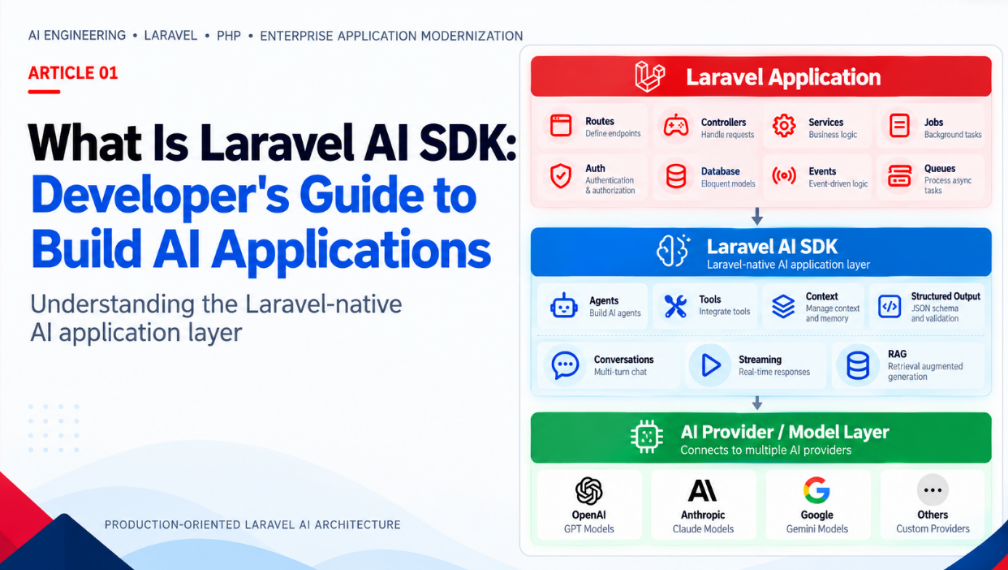
Artificial intelligence is rapidly becoming part of modern business applications. For Laravel teams, the engineering challenge is not simply connecting to an AI provider; it is designing an application architecture in which AI behavior, data, tools, security and business workflows work together.
Architecture Flow
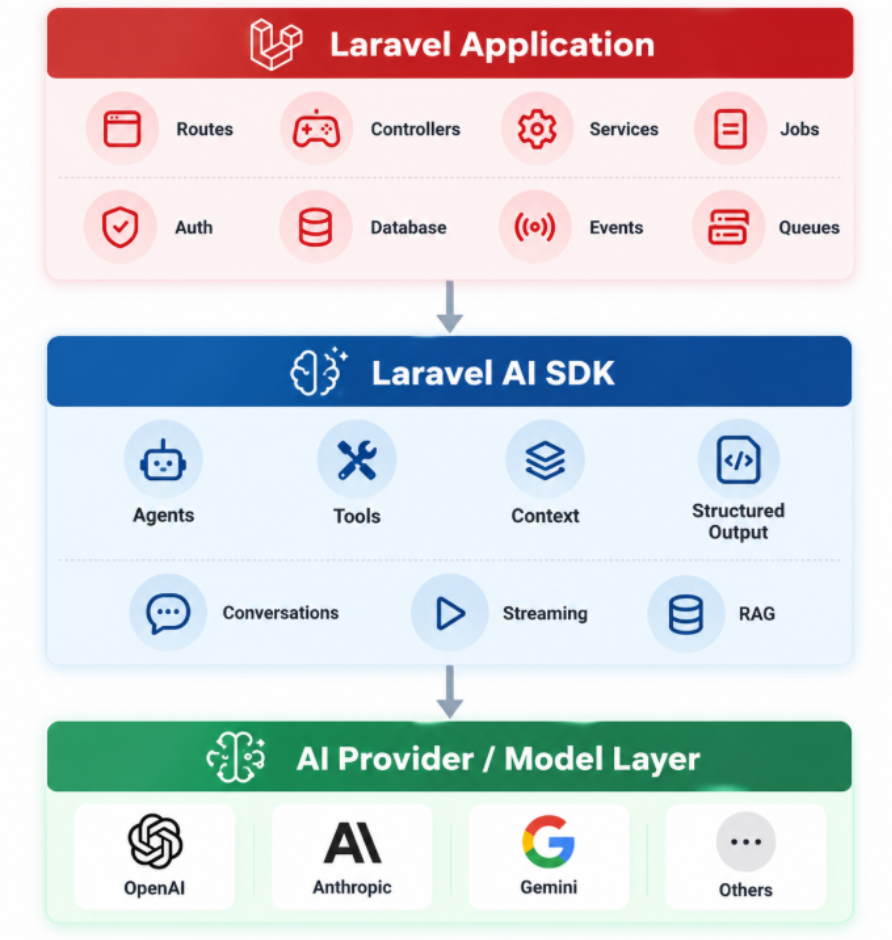
Figure — What Is Laravel AI SDK? A Developer’s Guide to Laravel AI Applications architecture flow
Introduction
Artificial intelligence is moving from isolated experiments into production business applications. For Laravel teams, that transition changes more than the API call used to reach a model.
A production AI application may need agents, tools, structured responses, conversation history, application data, retrieval, provider selection, approvals, testing, observability and security. Laravel AI SDK provides a Laravel-native place to organize these capabilities.
The central architectural idea is simple: the AI model provides intelligence, while Laravel remains responsible for application rules, authorization, persistence, workflows and execution.
What Is Laravel AI SDK?
Laravel AI SDK is Laravel’s first-party SDK for integrating AI capabilities into Laravel applications through a consistent Laravel-friendly API.
Instead of scattering provider calls across controllers and services, teams can organize AI behavior into dedicated agents and tools and connect those components to the existing Laravel application.
The SDK approach is especially useful when an application grows beyond a single prompt-and-response feature.
Why a Dedicated AI Layer Matters
A prototype can start with a direct HTTP request to an AI provider. As the feature grows, the application may need multiple providers, different models, conversation history, tool invocation, structured responses, retrieval, human approval, streaming, background processing, failover, testing, logging and usage monitoring.
A dedicated AI layer creates a consistent location for these concerns while keeping conventional Laravel responsibilities intact.
Core Capabilities
The source guide identifies agents, tools, structured output, conversations, streaming, embeddings, vector stores, media capabilities, classification, human tool approval, failover and testing as important capabilities.
These capabilities should be introduced according to the application’s requirements rather than added simply because they are available.
Installation and First Steps
The source guide uses Composer installation with the Laravel AI package, followed by publishing configuration and migrations and configuring provider credentials through environment variables.
After installation, a practical first milestone is a small agent with a clear responsibility. From there, tools, context, structured output and other production capabilities can be added incrementally.
When Laravel AI SDK Becomes Most Useful
The SDK becomes particularly relevant when AI must interact with application data or controlled application functionality, when responses need to feed deterministic workflows, or when the system needs operational controls around AI behavior.
For enterprise applications, the surrounding architecture is as important as the model itself.
Key Takeaways
Treat Laravel AI SDK as an application foundation rather than merely another API wrapper.
Keep business rules and authorization in Laravel.
Use agents for AI behavior, tools for controlled capabilities and structured output for machine-processable results.
Add RAG, memory, approvals, failover and observability when the business problem requires them.
Production Implementation Pattern
- Start with one bounded AI use case.
- Create a dedicated agent responsibility.
- Expose application capabilities through controlled tools.
- Add structured output when downstream logic needs machine-readable data.
- Introduce retrieval, memory, approval, failover and observability according to requirements.
Frequently Asked Questions
What is Laravel AI SDK?
It is Laravel’s first-party SDK for integrating AI capabilities through a consistent Laravel-native API.
Is it suitable for enterprise applications?
It provides production-oriented capabilities, but enterprise suitability still depends on security, compliance, architecture and operational requirements.
Can it support multiple providers?
The source guide describes multi-provider support and provider/model failover.
What are Laravel AI agents?
Dedicated PHP classes that encapsulate AI instructions, context, tools and, where required, structured output.
Build Your AI-Powered Laravel Application with DeepCoder
AI adoption is moving from experimentation toward production application architecture. Organizations need more than an AI model; they need application engineering, AI integration, security, cloud infrastructure, data architecture, governance and operational expertise.
DeepCoder helps organizations design, develop and modernize enterprise applications with AI engineering, Laravel/PHP development, enterprise integrations and production-oriented architecture.
Talk to DeepCoder • [email protected] • www.DeepCoder.io
Recommended Reading in This Laravel AI Series
Editorial note: This article is derived from the DeepCoder Laravel AI SDK Production Guide and preserves its production-oriented architecture, terminology and flow diagrams.