Artificial intelligence is rapidly becoming part of modern business applications. For Laravel teams, the engineering challenge is not simply connecting to an AI provider; it is designing an application architecture in which AI behavior, data, tools, security and business workflows work together.
Architecture Flow
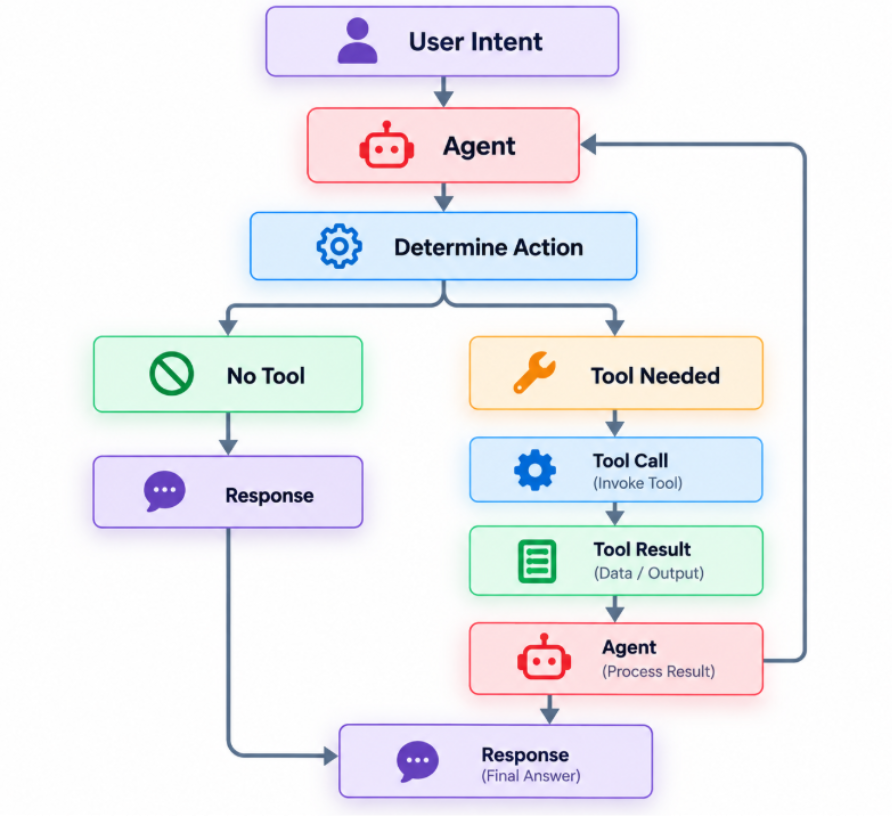
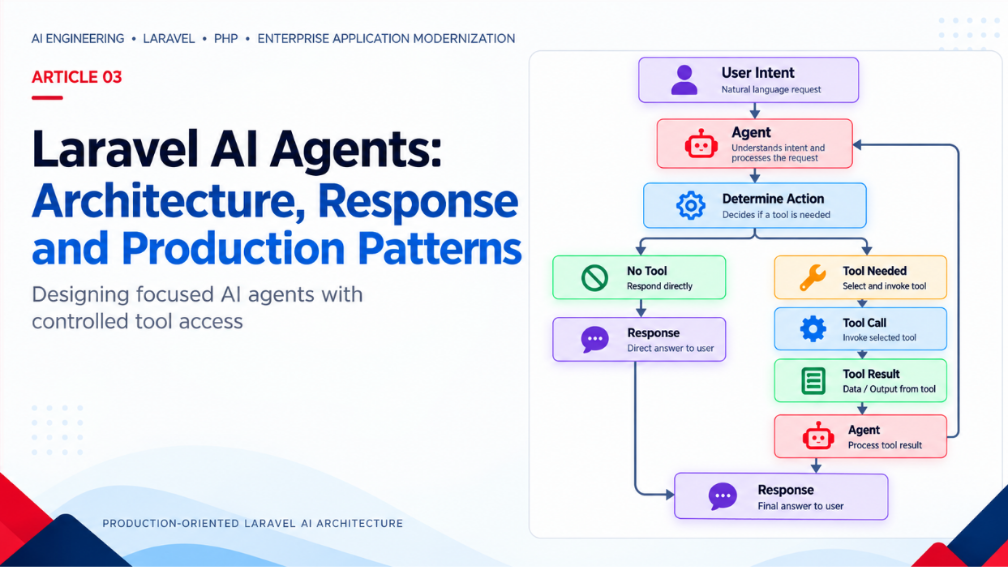
Figure — Laravel AI Agents: Architecture, Responsibilities and Production Patterns architecture flow
Introduction
Agents are one of the core concepts in the Laravel AI SDK approach. An agent provides a dedicated location for AI instructions, context, tools and, where appropriate, structured output.
This separation helps prevent AI behavior from becoming a collection of prompts and provider calls scattered throughout the application.
What Is an AI Agent?
An AI agent is a focused component that interprets a request, uses the context available to it, determines whether a tool is needed and produces a response or structured result.
The source guide illustrates the basic flow as User Intent → Agent → Determine Action → No Tool or Tool Needed → Response.
Agent Responsibilities
A well-defined agent should have a clear purpose. It may represent customer support, sales qualification, document analysis, internal knowledge assistance or another bounded business capability.
The agent can hold instructions and coordinate tools, but application authorization and deterministic business rules should remain outside the model’s control.
Agent + Tool Selection
When an agent needs application information or an action, it can request a specific tool. The tool should have a defined schema and handler.
This allows the application to expose only the capabilities the agent actually needs.
Context and Memory
Agents can use conversation history, user information, application data and the current request as context. The source guide emphasizes that more context does not automatically mean better results.
Context should be relevant, permission-aware and limited to what is required.
Designing Production Agents
Start with one responsibility and a small tool set. Define the expected output. Identify sensitive actions. Decide which actions require human approval. Add retrieval or sub-agents only when the workflow needs them.
This incremental approach keeps the agent understandable and easier to test.
Agent Testing
AI behavior is not deterministic in the same way as a conventional function. Testing should therefore include expected output, failure scenarios, tool behavior, structured schema validation, provider failures and approval workflows.
Key Takeaways
Give each agent a clear responsibility.
Keep tools controlled and least-privileged.
Treat context as an architectural input rather than unlimited conversation history.
Keep authorization and execution in the application.
Production Implementation Pattern
- Define one responsibility per agent.
- Keep the initial tool set small.
- Provide only relevant context.
- Define expected output.
- Test tool calls and failure scenarios independently.
Frequently Asked Questions
What is a Laravel AI agent?
A dedicated component that encapsulates AI instructions, context, tools and, where required, structured output.
Should one agent handle everything?
Not necessarily. The source guide recommends multiple agents only when responsibilities are clearly separated or the workflow requires delegation.
Can an agent execute business actions?
It can request controlled tools, while authorization and execution remain application responsibilities.
Build Your AI-Powered Laravel Application with DeepCoder
AI adoption is moving from experimentation toward production application architecture. Organizations need more than an AI model; they need application engineering, AI integration, security, cloud infrastructure, data architecture, governance and operational expertise.
DeepCoder helps organizations design, develop and modernize enterprise applications with AI engineering, Laravel/PHP development, enterprise integrations and production-oriented architecture.
Talk to DeepCoder • [email protected] • www.DeepCoder.io
Recommended Reading in This Laravel AI Series
Editorial note: This article is derived from the DeepCoder Laravel AI SDK Production Guide and preserves its production-oriented architecture, terminology and flow diagrams.