Artificial intelligence is rapidly becoming part of modern business applications. For Laravel teams, the engineering challenge is not simply connecting to an AI provider; it is designing an application architecture in which AI behavior, data, tools, security and business workflows work together.
Architecture Flow
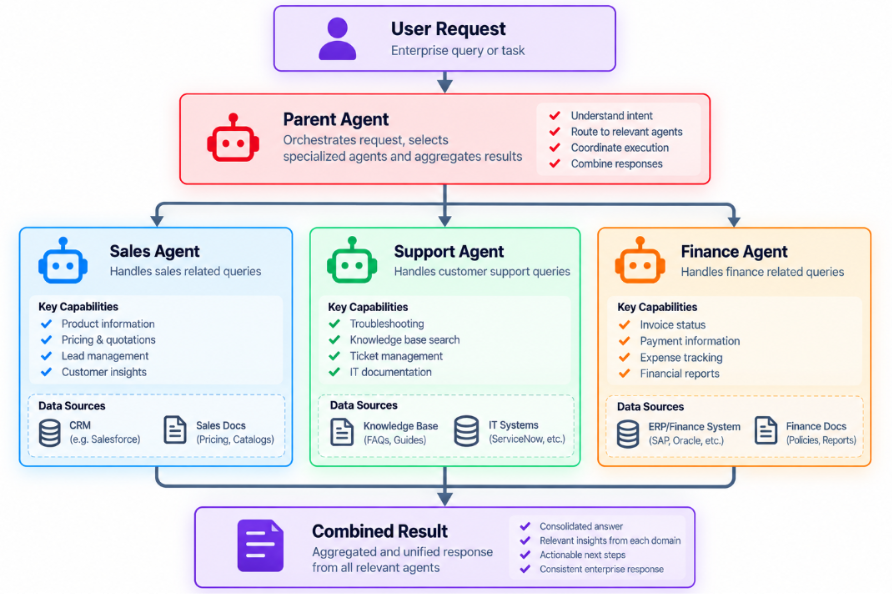
Figure — Multi-Agent AI Architecture in Laravel: When and How to Use Multiple Agents architecture flow
Introduction
Some business processes are too broad for a single agent. A parent agent can delegate specialized tasks to agents with focused responsibilities, tools and instructions.
The Laravel AI SDK supports sub-agent workflows and agent delegation, but the source guide recommends introducing multiple agents because the problem requires them—not simply because the capability exists.
What Is a Multi-Agent Workflow?
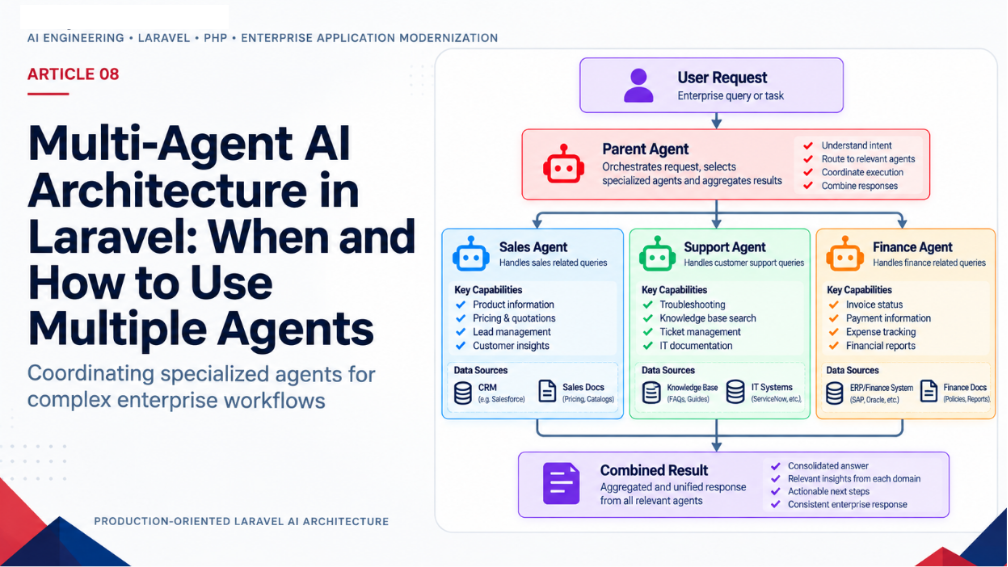
A parent agent receives a request and delegates parts of the work to specialized agents. The source architecture illustrates Sales, Support and Finance agents working under a Parent Agent and returning a Combined Result.
Why Specialize Agents?
Specialization can provide clearer instructions, smaller tool sets and better separation of responsibilities. A sales agent may work with CRM tools, a support agent with knowledge retrieval and ticket tools, and a finance agent with financial workflow capabilities.
When Multiple Agents Can Help
The source guide identifies clear responsibility separation, different tools, different instructions, independent task execution and parent-level coordination as situations where multi-agent architecture can be useful.
The Complexity Trade-Off
Multiple agents introduce more model calls, additional latency, more state, more failure points, more complex debugging and potentially increased cost.
A single well-designed agent may be easier to operate when the workflow does not truly require specialization.
Designing the Parent Agent
The parent agent should have a clear orchestration role. It should determine which specialist is relevant, provide the required context and combine results according to application rules.
Critical authorization should remain in the application rather than being delegated to the parent agent.
Testing Multi-Agent Workflows
Testing should cover delegation decisions, specialist behavior, tool failures, partial results, timeouts and final result construction. Observability becomes particularly important because a single user request may produce several AI operations.
Key Takeaways
Use multiple agents when responsibilities are genuinely different.
Keep each agent focused and least-privileged.
Design for partial failure and increased operational complexity.
Production Implementation Pattern
- Identify specialist responsibilities.
- Create focused agents and tool sets.
- Use a parent agent for coordination.
- Handle partial failures.
- Monitor model calls, latency and cost.
Frequently Asked Questions
What is a multi-agent system?
A workflow in which a parent or coordinating agent delegates work to specialized agents.
Does more agents mean better AI?
Not automatically. The source guide notes increased complexity, latency, failure points and cost.
What should specialists have?
Focused responsibilities, relevant instructions, appropriate tools and only the context they need.
Build Your AI-Powered Laravel Application with DeepCoder
AI adoption is moving from experimentation toward production application architecture. Organizations need more than an AI model; they need application engineering, AI integration, security, cloud infrastructure, data architecture, governance and operational expertise.
DeepCoder helps organizations design, develop and modernize enterprise applications with AI engineering, Laravel/PHP development, enterprise integrations and production-oriented architecture.
Talk to DeepCoder • [email protected] • www.DeepCoder.io
Recommended Reading in This Laravel AI Series
Editorial note: This article is derived from the DeepCoder Laravel AI SDK Production Guide and preserves its production-oriented architecture, terminology and flow diagrams.