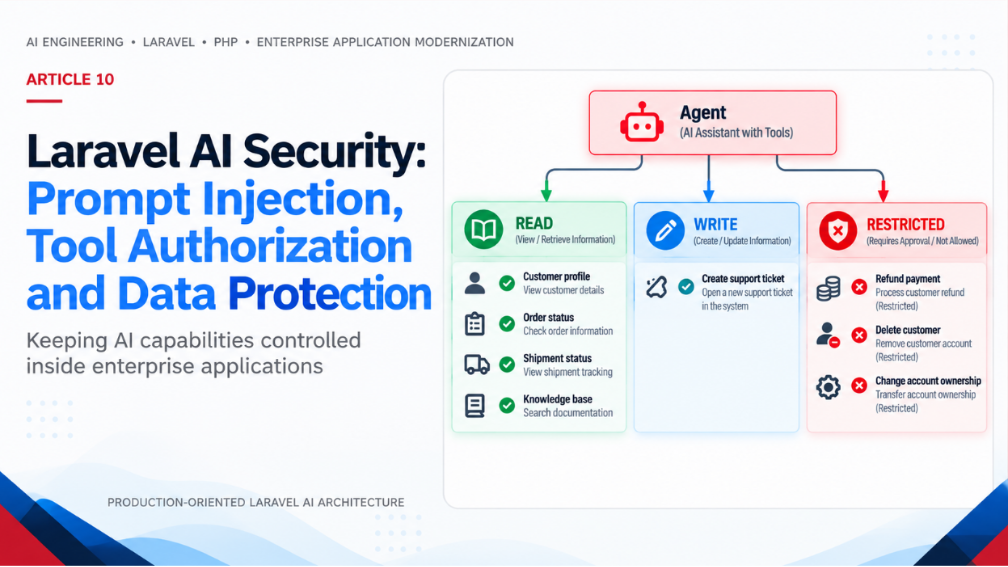
Artificial intelligence is rapidly becoming part of modern business applications. For Laravel teams, the engineering challenge is not simply connecting to an AI provider; it is designing an application architecture in which AI behavior, data, tools, security and business workflows work together.
Architecture Flow
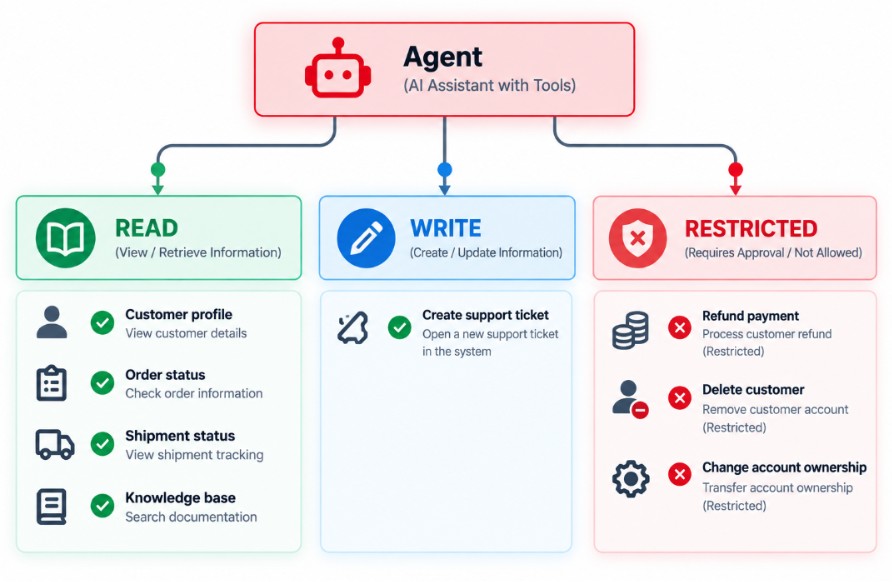
Figure — Laravel AI Security: Prompt Injection, Tool Authorization and Data Protection architecture flow
Introduction
AI introduces new security considerations because models can interpret untrusted instructions, generate unexpected outputs and request application actions through tools.
The source guide treats security as an application responsibility and emphasizes authorization, tenant isolation, data protection, tool-level controls and output validation.
Prompt Injection
Prompt injection occurs when untrusted content attempts to influence the AI workflow beyond the intended task. The source guide emphasizes that prompts should not be treated as the complete security boundary.
Security controls must exist outside the model, particularly around authorization and execution.
Tool Authorization
An agent should not automatically gain access to every application operation. The application should explicitly define which tools are available, what inputs they accept, which users are authorized and which operations require approval.
This creates a controlled boundary around AI-assisted actions.
Least Privilege
The source guide recommends least-privilege tool design. Read-only access can be separated from write operations, while restricted operations can require stronger authorization or human approval.
This principle reduces the impact of incorrect or manipulated AI requests.
Sensitive Data Protection
The source guide identifies personally identifiable information, financial information, credentials, internal business information, customer information and confidential documents as data categories that require careful handling.
Data handling should align with organizational security and compliance requirements.
Tenant Isolation and Access Control
In multi-tenant applications, retrieval and tool operations must be constrained to the current user’s authorized tenant and records. Application authorization should happen before sensitive data becomes AI context.
Output Validation
AI-generated output should never be assumed to be safe to execute. Structured output should be validated against schemas and then checked against business rules before reaching critical workflows.
For sensitive actions, validation can be combined with human approval.
Human Approval for Sensitive Actions
The source architecture supports approval workflows where an agent requests an action, the application checks authorization and a human can approve or reject the execution.
This is particularly relevant for high-impact operations such as financial changes, record modification or account actions.
Security Checklist
Authentication implemented; authorization enforced; tool access restricted; sensitive information protected; prompt injection considered; AI output validated; RAG documents permission-aware; audit information available; high-impact workflows given additional controls.
Key Takeaways
AI should operate inside application security boundaries.
Prompts are not authorization mechanisms.
Tools need least privilege, validation and approval where appropriate.
Sensitive data requires deliberate handling before it reaches the model.
Production Implementation Pattern
- Authenticate users.
- Authorize tools and data.
- Apply least privilege.
- Validate AI output.
- Require human approval for sensitive operations and maintain audit records.
Frequently Asked Questions
Can a prompt be a security boundary?
No. The source guide states that authorization, tenant isolation, database policies and tool-level controls should enforce security.
What is least-privilege AI tooling?
Giving an agent only the minimum tools and permissions required for its responsibility.
Should AI output be trusted?
No. AI-generated output should be validated before it drives business-critical workflows.
Build Your AI-Powered Laravel Application with DeepCoder
AI adoption is moving from experimentation toward production application architecture. Organizations need more than an AI model; they need application engineering, AI integration, security, cloud infrastructure, data architecture, governance and operational expertise.
DeepCoder helps organizations design, develop and modernize enterprise applications with AI engineering, Laravel/PHP development, enterprise integrations and production-oriented architecture.
Talk to DeepCoder • [email protected] • www.DeepCoder.io
Recommended Reading in This Laravel AI Series
Editorial note: This article is derived from the DeepCoder Laravel AI SDK Production Guide and preserves its production-oriented architecture, terminology and flow diagrams.