Artificial intelligence is rapidly becoming part of modern business applications. For Laravel teams, the engineering challenge is not simply connecting to an AI provider; it is designing an application architecture in which AI behavior, data, tools, security and business workflows work together.
Architecture Flow
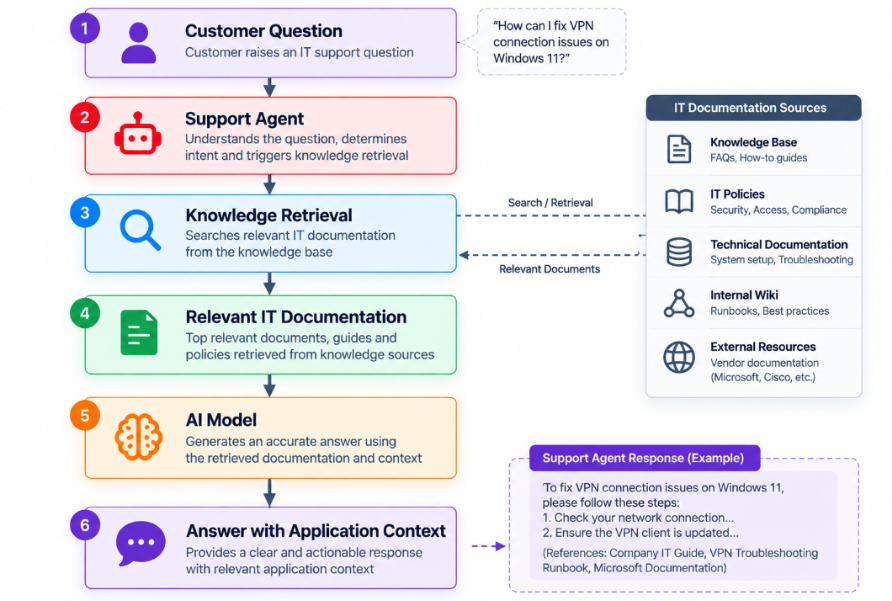
Figure — Laravel RAG: Building Retrieval-Augmented Generation Applications architecture flow
Introduction
Large language models provide general knowledge, but enterprise applications frequently need access to private or application-specific information such as product documentation, HR policies, contracts, customer documentation and internal knowledge bases.
Retrieval-Augmented Generation, commonly called RAG, provides a way to retrieve relevant information and supply it as context to the model.
What Is RAG?
A RAG workflow typically begins with a user question. The agent or application creates a retrieval request, searches a knowledge or vector store, selects relevant documents and supplies them as context to the model before generating an answer.
The source guide identifies embeddings, vector stores and retrieval-related capabilities as part of the Laravel AI SDK ecosystem.
RAG Architecture
The source flow is User Question → Agent → Query/Retrieval → Knowledge/Vector Store → Relevant Documents → Context → Model → Answer.
This separates knowledge retrieval from generation and gives the application an opportunity to enforce document permissions and filtering.
RAG Does Not Automatically Guarantee Accuracy
The source guide explicitly notes that RAG does not automatically guarantee factual answers. Retrieval quality, document quality, chunking, ranking, metadata filtering and application validation remain important.
A vector database alone is therefore not a complete RAG strategy.
What to Monitor
A production RAG implementation should monitor retrieval relevance, missing documents, outdated information, duplicate content, access permissions, latency and token usage.
These signals help teams understand whether poor answers originate in retrieval, documents, context construction or model behavior.
Enterprise RAG Example
The source guide presents an enterprise support scenario where a customer asks how to configure device enrollment for corporate laptops. The support agent retrieves relevant IT documentation and uses it as context for the response.
This pattern can be applied to technical manuals, support documentation, internal policies and other enterprise knowledge.
RAG Security
Knowledge sources can contain sensitive information. Retrieval should therefore respect document permissions, tenant boundaries and data-handling requirements before content is supplied to the model.
Key Takeaways
RAG connects AI applications to private and current knowledge.
Retrieval quality is a first-class engineering concern.
Permissions and document freshness matter as much as the vector store.
Production Implementation Pattern
- Index authoritative knowledge.
- Retrieve relevant documents.
- Apply metadata and permission filters.
- Construct focused context.
- Measure retrieval relevance and freshness.
Frequently Asked Questions
What is RAG?
Retrieval-Augmented Generation retrieves relevant information and supplies it to an AI model as context.
Does RAG eliminate hallucinations?
No. The source guide states that retrieval quality, document quality and application validation remain important.
What data can RAG use?
The guide lists product documentation, policies, contracts, customer documentation, internal knowledge bases, catalogs and support documentation.
Build Your AI-Powered Laravel Application with DeepCoder
AI adoption is moving from experimentation toward production application architecture. Organizations need more than an AI model; they need application engineering, AI integration, security, cloud infrastructure, data architecture, governance and operational expertise.
DeepCoder helps organizations design, develop and modernize enterprise applications with AI engineering, Laravel/PHP development, enterprise integrations and production-oriented architecture.
Talk to DeepCoder • [email protected] • www.DeepCoder.io
Recommended Reading in This Laravel AI Series
Editorial note: This article is derived from the DeepCoder Laravel AI SDK Production Guide and preserves its production-oriented architecture, terminology and flow diagrams.