Artificial intelligence is rapidly becoming part of modern business applications. For Laravel teams, the engineering challenge is not simply connecting to an AI provider; it is designing an application architecture in which AI behavior, data, tools, security and business workflows work together.
Architecture Flow
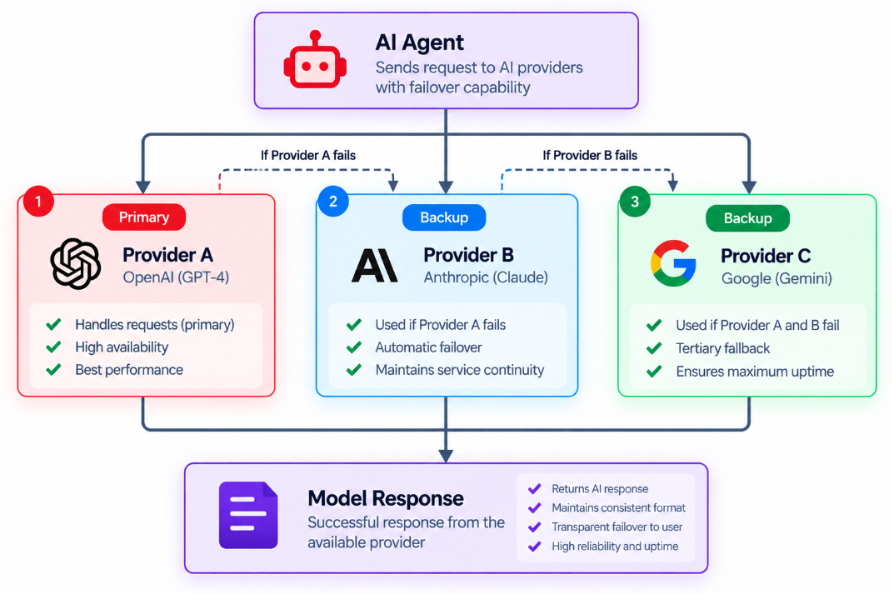
Figure — Multi-Provider AI Architecture in Laravel: Failover, Routing and Reliability architecture flow
Introduction
Enterprise organizations may not want to depend entirely on one AI provider. Availability, pricing, performance, regional requirements, model capabilities and business continuity can all influence provider strategy.
A multi-provider architecture can introduce abstraction and failover around the AI model layer while keeping the application architecture stable.
Why Multi-Provider Architecture?
The source guide identifies availability, pricing, performance, data requirements, regional requirements, model capabilities and business continuity as reasons organizations may consider multiple providers.
Failover Architecture
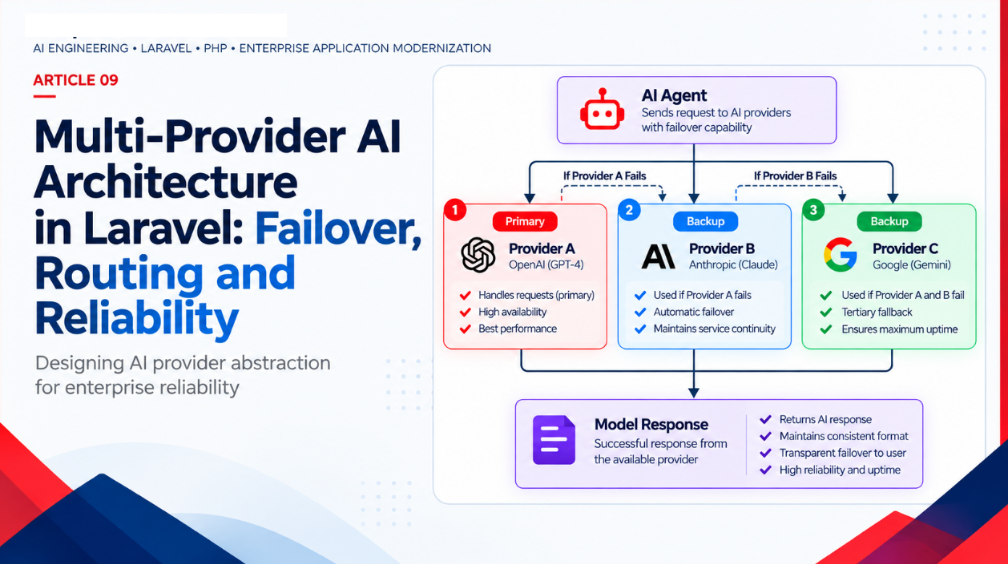
The source diagram shows an AI Agent connected to Provider A, Provider B and Provider C, followed by a Model Response. The purpose is to provide a controlled strategy when a primary provider or model cannot complete the request.
Provider Abstraction
Provider abstraction keeps provider-specific details from spreading throughout the application. The agent and application can work with a consistent AI interface while configuration determines the appropriate provider and model.
This can make provider changes easier to test and deploy.
Routing Considerations
Different tasks may have different requirements. A system can consider model capabilities, latency, cost, data handling requirements and availability when determining which provider or model should serve a request.
Routing rules should remain observable and testable.
Failure Handling
Providers can experience rate limits, timeouts, service interruptions and model changes. Enterprise systems should define timeout, retry and fallback behavior rather than assuming the provider is always available.
Governance and Data
Provider selection can also be influenced by data handling and regional requirements. Sensitive data should be evaluated before it is sent to any provider, and provider choices should align with organizational security and compliance requirements.
Key Takeaways
Use provider abstraction to reduce application coupling.
Define explicit timeout, retry and failover behavior.
Consider cost, latency, capabilities, data requirements and business continuity.
Monitor provider-level failures and usage.
Production Implementation Pattern
- Abstract provider access.
- Define primary and fallback paths.
- Configure timeouts and retries.
- Monitor provider performance.
- Test failover before production.
Frequently Asked Questions
Why use multiple AI providers?
The source guide identifies availability, pricing, performance, data requirements, regional requirements, model capabilities and business continuity.
What is provider failover?
A strategy for using an alternate provider or model when the preferred option cannot complete a request.
Does multi-provider architecture eliminate failures?
No. It creates additional options but also requires routing, monitoring and testing.
Build Your AI-Powered Laravel Application with DeepCoder
AI adoption is moving from experimentation toward production application architecture. Organizations need more than an AI model; they need application engineering, AI integration, security, cloud infrastructure, data architecture, governance and operational expertise.
DeepCoder helps organizations design, develop and modernize enterprise applications with AI engineering, Laravel/PHP development, enterprise integrations and production-oriented architecture.
Talk to DeepCoder • [email protected] • www.DeepCoder.io
Recommended Reading in This Laravel AI Series
Editorial note: This article is derived from the DeepCoder Laravel AI SDK Production Guide and preserves its production-oriented architecture, terminology and flow diagrams.